

Ask anyone who has ever hired for a role how it went, and you rarely hear a straight line. You hear a story that wanders.
It usually starts with a simple sentence: “We need someone for this.” Then the wandering begins. You write the job post. You wait. You open one tab for resumes, another for messages, a spreadsheet for shortlists, a calendar for interviews, a chat thread for the panel’s feedback, and an email draft for the offer. By the time someone finally says yes, you are holding a dozen half-finished tasks in your head and hoping none of them slipped.
Hiring was never one task. Somewhere along the way, though, our tools started treating it like twelve unrelated ones.
The gap is not effort. It is connection.
Most hiring teams are not short on tools. They have a job board here, a resume folder there, a scheduling link, a messaging app, maybe an AI resume screener bolted on at the end. Each one does its job. None of them talk to each other.
So the recruiter becomes the glue. They copy a name from one screen into another. They remember which candidate was “warm” and which one went quiet. They chase feedback that lives in three different inboxes. The work that actually needs a human — judgement, empathy, the decision about who is right for the team — gets squeezed between all the stitching.
That is the part we kept coming back to while building Koovira Jobs. The problem was almost never the individual step. The problem was the space between the steps.
What “connected” actually means
We wanted Koovira Jobs to hold the whole journey in one place, so a role could move from a need to a hire without being re-typed at every stage:
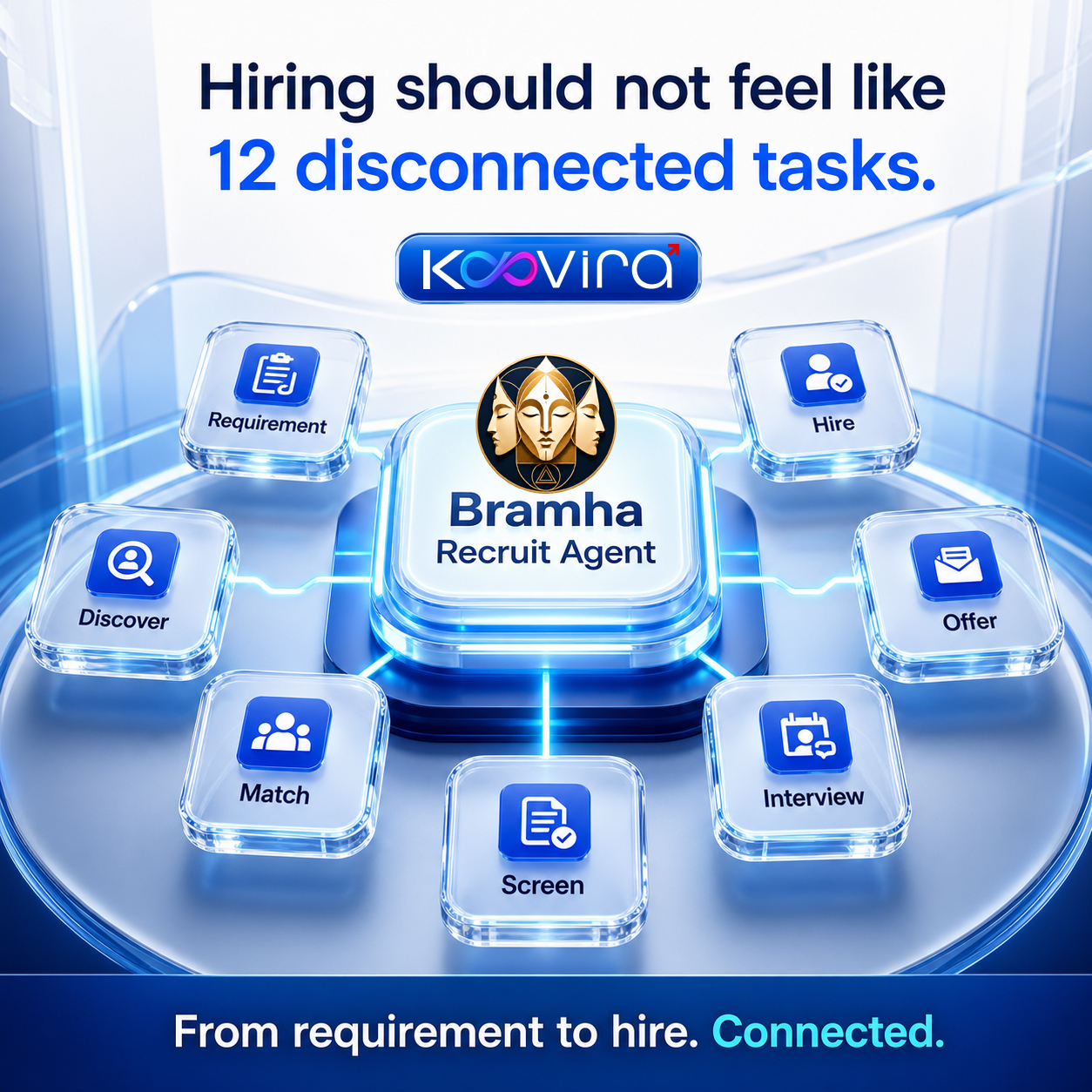
Requirement → Discover → Match → Reach → Screen → Interview → Offer → Hire.
You describe who you need in plain language. That turns into a structured requirement — skills, experience, salary band, location, notice period, the questions worth asking. From there, candidate discovery, outreach across chat, email and WhatsApp, structured screening, interview scheduling, scorecards, and offers all sit on the same thread. And when a strong candidate is not right for this role, they are not lost — they wait in your talent pool for the next one.
Where Bramha helps, and where it stays out of the way
Somewhere in the middle of all this sits Bramha Recruit Agent. It is easy to be cynical about AI in hiring, and honestly, we were too. Nobody wants a black box quietly deciding who gets a job and who does not.
So we drew a clear line. Bramha does the repetitive, structuring work — turning a rough brief into a proper requirement, surfacing candidates and explaining why each one fits, drafting outreach, organising screening responses, keeping interviews and feedback tidy. What it never does is make the call for you.
That principle became our short version of the whole thing: AI assistance where it helps. Human decisions where they matter.
A recommendation should come with a reason, not a mysterious score. A shortlist should be a starting point for a conversation, not a verdict. The recruiter stays in the driver’s seat the entire way.
Not another job board
There are plenty of places to publish a vacancy. Koovira Jobs is meant to be something different — a connected recruitment workspace where professional identity, resumes, skills, communication, interviews, campus talent and employer workflow finally work together instead of in separate corners.
Because hiring should not feel like twelve disconnected tasks. It should feel like one clear journey, with the right people in control of it.
Koovira Jobs. From requirement to hire. Connected.